Showing posts with label Book of the Month. Show all posts

Monday, January 3, 2022

Book of the Month: January 2019


Offered Books:
The Night Tiger by Yangsze Choo
Golden State by Ben H. Winters
The Silent Patient by Alex Michaelides
Maid by Stephanie Land
Golden Child by Claire Adam

Selected:
The Silent Patient by Alex Michaelides

Other Purchased:
None - yet


I am in the minority opinion on this book.  It has the distinction (along with the previously reviewed Future Home of the Living God, The Perfect Mother, and The Chalk Man) of being one of the rare books to get the 'dislike' option when rating it at the Book of the Month website.  Contrast this with it making the finalist list for Book of the Year at the same site - in fact, as of the typing of this review only 3% of members who have voted have given it the dreaded 'dislike.'  Why does my opinion differ from so many others?  The ending, my dear friends, the ending.

I'm not going to lie: this book had me going.  I tore through it eagerly wanting to see how it resolved itself.  Any mild qualms I came across were pushed aside as I powered through to see what happened on the fateful night where Alicia Berenson murdered her husband.  Then, in the last 20 or so pages, it all fell apart.  The reveal was so convoluted, so stupid, that it made me angry that I had read the book with such passion.  In fact, so angered was I by the ending of the book, that looking back at the minor qualms I had made me feel like I had ignored numerous red flags placed throughout the novel.  The story itself had tried to warn me of the imminent disappointment... and I ignored it.

To expand on my brief summary above, Alicia Berenson has murdered her husband - both of them fairly famous - and then refused to say anything about what had transpired that evening that had caused her to shoot him multiple times.  Five years have passed, Alicia has been committed, and Theo Faber - a criminal psychotherapist - works for the opportunity to examine the famous mystery.

It is here where the first of the major red flags appears: Alicia starts talking to Theo fairly quickly.  This isn't much of a spoiler (there would not be much of a novel without this development), but no one really comments on his quick success.  There's a few passing mentions of his ability to get her to open up, but for a well-known woman who famously refused to speak for five years.  It feels like, at the very least, the other doctors should have reacted.  Someone needed to remark on it, and the fact that no one really does destroys the world-building done up to this point.

I can't much into details of the other parts that should have served as a warning to me - far too plot relevant to reveal - but they are very much in the same vein as the above one: Why hasn't anyone else comment on [x]?  Why did no one think to [y]?  All of them could be addressed fairly quickly and without a bunch of text but they just aren't.

And it pains me, because so much of the novel is so good - Theo and Alicia are interesting characters and the pace of the book is well done.  The tone is well-managed without ever being too much.  Really, if the ending had so completely and utterly disappointed me, it might have been one of my favorites of the year.

But again, I am in the minority on this opinion.  This book is widely beloved by those that read it: I cannot give it a recommend, but with the caveat that most people definitely would.

1.5 out of 5 - maybe a 2 out of 5 depending on my mood.

Author Links:

Monday, October 11, 2021

Book of the Month: December 2018


Offered Books:
The Far Field by Madhuri Vijay
One Day in December by Josie Silver
An Anonymous Girl by Greer Hendricks & Sarah Pekkanen
Severance by Ling Ma
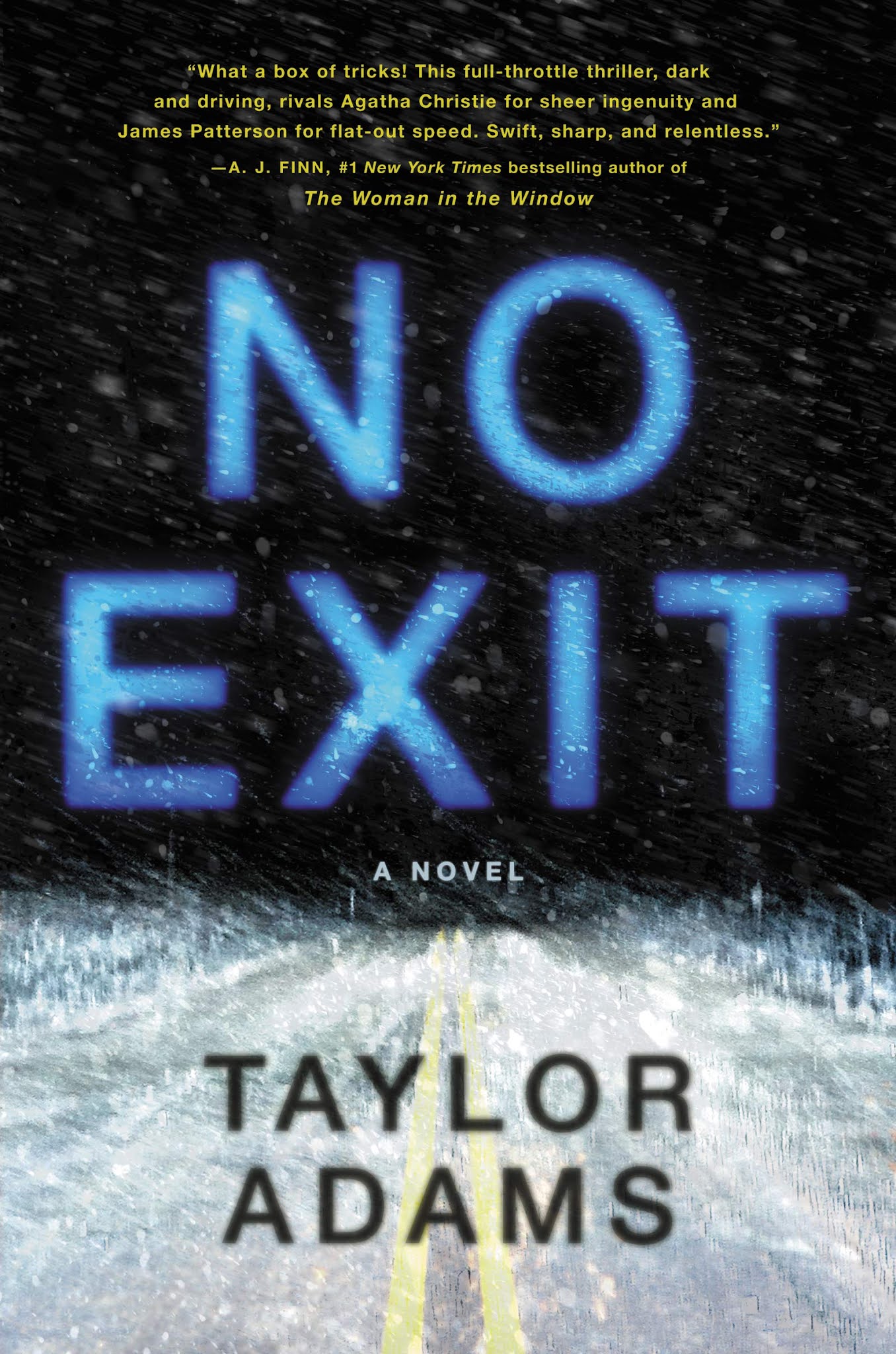
No Exit by Taylor Adams

Selected:
No Exit by Taylor Adams

Others Purchased:
Severance by Ling Ma


Sometimes a novel is hard to review through no fault of its own: maybe it was a genre that the critic is overly familiar with, so twists and turns are more easily spotted.  Maybe they couldn't connect with the main character for whatever reason, so they didn't get as invested in the action.  Or maybe the reviewer is just not in a reading mood, but still forces their way through the book out of a sense of obligation.  That final point colors my opinions on this book.

I am a big proponent of reading what you like (get 30 pages into a novel and not enjoy it?  Shelve it and move to something else!) and have thankfully reached a point where I will not force myself to continue reading a book that I do not enjoy just because I have finished it.  Life is too short to turn a leisure activity into work.

The problem with this book is, when I started it, I very much enjoyed it.  It follows Darby Thorne as she drives back to her dying mother, but gets caught in a snowstorm in Colorado and is stuck at a rest stop with several other people.  While there, she discovers a kidnapped child in one of the other vehicles, with no idea who drives it.

Great premise, right?  I got to around the point where Darby finds the child when I suddenly hit a wall:  I just didn't feel like reading.  And not just this novel - any other book I picked up was quickly set aside.  This is not a rare occurrence in of itself, but for it to happen in the middle of a novel is rare.  To make matters worse, despite forcing myself through this book, it still took me around two months to finish it (for context, a novel of this length is normally something I can read within a day or two).

Which is why reviewing this book is hard - so much momentum was lost just in the process of reading it that I don't know if the novel was draggy in areas, or if it was a symptom of my reader's block (for lack of a better term).  Thinking about it, I do think it was a bit slow towards the beginning, but once the main action started, it was a solid read.  The characters were believable, the villain was appropriately threatening, and Darby is an all-around great protagonist: I just had a hard time reading the book, so it is hard for me to say that I loved it, or even give it a full-hearted recommend.

It's worth a read, and maybe you'll enjoy it more than I did.

2.5 out of 5


If No Exit was a novel that just had the misfortune to be read at the wrong time, then Ling Ma's Severance is one that benefited greatly from the timing of its reading.  It follows Candace Chen, a millennial working an office job that she does not love - but pays well - when there is suddenly a worldwide plague that is killing off the majority of the population.  While initially everyone thinks 'Shen Fever' will be easily handled, it soon upsets the global supply chain and Candace finds herself essentially alone in New York City.

This was released in December of 2018.

It boggles my mind how prescient this novel ended up being when I finally read it in March of this year.  While it was initially categorized as a satire, it's hard to read it as one in a post-COVID world.  And it makes me glad to have read it later: I was already the in target audience for this novel and reading it this year gives me an appreciation for how well Ma crafted not only her protagonist, but how well Ma understood how a global pandemic would effect people.

Candace is an outstanding character - the novel is told entirely from her perspective, and Ma allows the reader to see both the good and the bad of her without having Candace be too knowledgeable of other character's motivations or softening Candace's harder edges.

The first half of the novel primarily focuses on getting to know Candace and how she arrived at her current job, with a bit of alluding to the world at large and the growing problems also.  The second and meatier half focuses on Candace after she meets with a group of survivors and starts traveling with them.

The part of the book focusing on the group is where the novel really shines.  Bob, the antagonist of the novel and the leader of the group, is a perfect villain: banal in his cruelty but savvy in his leadership.  The other members of the group have enough personality that you can differentiate them from one another, but not so overwhelming in idiosyncrasies that it detracts from the novel.  I might've liked more of the group dynamic to be explored, but - without giving too much away - it is understandable that Candace wouldn't be able to expand on that aspect.

I really enjoyed this book.  Maybe it hit me a bit harder than it normally would have due to COVID, but every millennial should give this one a go, or just any lover of post-apocalyptic literature.

5 out of 5.

Author Links:

Wednesday, September 8, 2021

Book of the Month: November 2018


Offered Books:
A Ladder to the Sky by John Boyne
Nine Perfect Strangers by Liane Moriarty
For Better and Worse by Margot Hunt
The Proposal by Jasmine Guillory
Unsheltered by Barbara Kingsolver

Selected:
The Proposal by Jasmine Guillory

Others Purchased:
Nine Perfect Strangers by Liane Moriarty


One of the goals I set for myself when I first signed up for Book of the Month was to force myself to try and read books in genres I normally skip.  With Jasmine Guillory's The Proposal, I finally ventured into a genre I still, to this day, only rarely go to: Romance.  I greatly enjoyed this foray into the genre - enough so to take another venture into it with another (future) Book of the Month selection - but, at the same time, feel woefully unsure of how to approach a review for a genre that I am so unfamiliar with.  Nevertheless, I will try.

I would venture to guess that one of the most important aspects of this sort of novel would be likeable characters - and our two main protagonists (Nikole and Carlos) have charm to spare.  Really, that would be a good one-word description of this book: charming.

I know the plot is a bit pedestrian - I could easily tell where the story is headed and what would happen next, even with my unfamiliarity with the genre - but the charm mentioned early easily buoys it as it progresses.  It does have one banger of an opening, and the resolution works well.  I can't really point to any aspect of the novel that doesn't work.

I think it is common when discussing books to look down at certain genres - YA, romance, non-Stephen King horror, among others - and often it is overlooking the fact that not every book needs to be the next Great American Novel.  Sometimes you need the literary equivalent of cotton candy - something sweet and fluffy to enjoy.  And there is nothing wrong with either reading or enjoying these types of novels.

Which might sound like long-winded way of saying I liked this book, and recommend it, but nevertheless, both of those facts are true.

3.5 out of 5


It feels a bit late to get to this review - he says writing this review almost 3 years after getting the book - especially with a limited series now airing for it (which I have not watched, but might try out).  But all of these reviews are late, so why let something like that stop me?

Nine Perfect Strangers follows... well, nine strangers, as they go to Tranquillum House, a health resort that promises to fix whatever it is that ails them.  Run by the enigmatic Masha, the book does a good job of following not only the journeys of each of the nine strangers, but also Masha and her employees.  There is not a single underdeveloped character in this book, which is a bit of a surprise given the size of the cast and how much happens during the novel.

I had heard of but not read any of Moriarty's previous novels, so I cannot compare it to her other works, but I can say that I was a fan of this one.  It's well paced, all of the characters are interesting - I cannot remember actively disliking any of them! - and the plot goes to exciting places without ever feeling histrionic or contrived - a tight rope to walk, given the events of the novel.

In fact, one of the greater issues I have reviewing this book is that it is best to go into knowing as little as possible.  Any deeper into the a summary of the plot would give too much away, and the most I feel like I could get away with is that Masha has unusual methods and things escalate.

However, anyone who loves high-stakes fiction is likely to enjoy this.  It's an easy recommend - and it is probably better to read this before watching the show.

4 out of 5

Author Links:

Wednesday, March 31, 2021

Book of the Month: October 2018


Offered Books:
The Clockmaker's Daughter by Kate Morton
An Absolutely Remarkable Thing by Hank Green
The Lies We Told by Camilla Way
In the Hurricane's Eye by Nathaniel Philbrick
Winter in Paradise by Elin Hilderbrand

Selected:
An Absolutely Remarkable Thing by Hank Green

Others Purchased:
None - yet


I felt pressured to like this book when I first selected it.  It had been highly recommended to me by a good friend - one that I had disagreed with before, though that was on movies moreso than books.  I did still select it, however, and read it fairly quickly after it arrived.  Did I like it?  Yes, for the most part.

The book quickly received a few strikes against it: The main character's name is April May, which it acknowledges as cheesy, but I still found it to be a bit too precious.  This was exacerbated by the 'voice' of April - the novel is told almost entirely from her perspective - driving home that somewhat-twee tone that I worried would dominate the novel.  Following that was a tendency in the early chapters to Drop Hints about what would happen later - mostly as chapter cliffhangers - and boy howdy was I about ready to write the novel off even as I forced myself to finish it.

Thankfully, April matures as the plot of the novel goes forward.  She and her friend Andy make a recording of a 10-foot tall sculpture in the middle of New York - which April dubs Carl - and it is soon discovered that these figures have appeared all over the world.  Not only that, but people also start experiencing a shared dream filled with puzzles.  As the first to document the existence of the Carls, April is thrust into the limelight as people discuss what to do about them and the shared dream.

One thing I appreciate about Green's plot structure is that he doesn't have everyone approach these two phenomena with benevolence: a main plot of the novel concerns April pushing back against Peter Petrawicki and his 'Defenders' who believe the Carls are malevolent and that the shared dream is an infection meant to destroy/enslave the human race.  This was released pre-COVID, and the threats/harassment April goes through is very reminiscent of how certain leaders treated those sounding the alarm about that disease.

Another aspect I want to give Green credit for is his ability to describe characters through April's perspective but still have them be strong enough that they feel independent of her narrative.  Maya, Andy, Robin, and Miranda - even Peter - all feel like actual characters.  And through subtle writing, Green allows the reader to have different opinions about those characters than April, which is quite a feat for a first-person narrative.

The novel also stands alone well despite being part 1 of a 2-parter.  In fact, the ending is kind of a perfect cliffhanger - so different from the early chapters that it feels almost unreal for both to be in the same book - and had me actually excited for the follow-up novel.  And I loved April by the end of it too.

An easy recommend.

4 out of 5

BONUS REVIEW!

So, as noted above, I was excited for this follow-up.  So much so that I made my first ever non-Stephen King preorder of a book.  While I had my criticisms for An Absolutely Remarkable Thing, it was an enjoyable book overall, and I had faith that Green would write a stronger second novel.  And I was correct.

Set shortly after the end of An Absolutely Remarkable Thing, A Beautifully Foolish Endeavor manages to expand on the previous novel in almost every conceivable way: The story is told through the perspectives of multiple characters instead of just April and expands the action so that the stakes feel appropriately epic in scale.  This novel has a book giving orders to people, a person trapped inside a simulation, and a character casually becoming a billionaire and none of it feels forced.  I cannot stress how wild that is to write: that's not even everything crazy that happens in this novel.

If Green had done a phenomenal job in the first novel of making the side characters independent of April despite it being her perspective - and he did - then this opportunity to delve into each of those character was not one to be wasted.  I can't fault a single one of them: every decision they make - even the bad ones - feels character appropriate as they make them.

The plot, without giving too much away, expands on the first novel with the Carls being a test - one that humanity didn't exactly pass - and the response to that 'failure.'  Each of the characters responds to their various circumstances without having a clear idea of what is happening to the others, which keeps the greater plot mysterious enough that the reader doesn't become frustrated even as they learn new things along with the characters.

If I have any critiques, they would primarily be some ideas being under-explored while spending too much time on subplots that, while necessary, feel overly-long.  I'd like to not only know more about the simulated world and how it works and less about the funding for/attempt to purchase said world.  Trust me, that sentence will make sense once you've read the actual book.

A great sequel, one that makes me hope we get more from Hank Green.

4.5 out of 5

Author Link:

Friday, March 12, 2021

Book of the Month: September 2018


Offered Books:
The Silence of the Girls by Pat Barker
Cross Her Heart by Sarah Pinborough
The Mermaid & Mrs. Hancock by Imogen Hermes Gowar
November Road by Lou Berney
#FashionVictim by Amina Akhtar

Selected:
The Silence of the Girls by Pat Barker

Others Purchased:
None - yet


Sometimes a book sticks with you long after you have read it.  Maybe not all the details, or even all the characters, but the story imprints on you so much that you know it will be something you read again throughout the years.  This category of book is a special one - books that will last you a lifetime are the best ones to read, though this is, sadly, not a universal experience for any book.  However, Pat Barker's The Silence of the Girls is one of those books for me.

The books follows Briseis - a former queen of a small nation conquered by the Greeks and now the forced concubine for Achilles as the Greek army attacks Troy.  Told entirely from her perspective, it expands on the Trojan War story that so many are familiar with by allowing one of the many woman who are ignored in the original tale to have a voice.

This is not a happy novel: Briseis is a prisoner, and though her relationships with Achilles and Patrocles warm throughout, it never glosses over or forgets that fact.  Still, it is not a parade of misery as Briseis learns how to survive her situation and bears witness to several major events from the original text.

Barker walks a tightrope of expanding the original story without taking it too far away from it.  Several of the major events are given interesting originations through this novel by virtue of allowing a character ignored in it to tell their side of it.  I'm not sure it works every single time - I'd say she tries to explain the Patrocles/Achilles relationship without committing to either of the popular interpretations of it, to the novel's detriment.  But this is a minor quibble at best.

For me, this is an easy recommendation to anyone who likes Greek legends and modern takes on them.  For anyone who enjoyed Circe, this should scratch that particular itch.  I'm not sure I'd say this is a better novel than that one, but I definitely connected to it more.

4.5 out of 5

Author Links:

Monday, January 18, 2021

Book of the Month: August 2018


Offered Books:
The Air You Breathe by Frances de Pontes Peebles
Sweet Little Lies by Caz Frear
The Dinner List by Rebecca Serle
The Line That Held Us by David Joy
Goodbye, Paris by Anstey Harris

Selected:
The Dinner List by Rebecca Serle

Other Purchased:
None - yet


Sabrina arrives at a dinner with her best friend, but finds 4 extra guests there, including Audrey Hepburn.  Having made and kept a 'dinner list' of 5 people for ages, she suddenly finds herself in the surreal situation of actually participating in one.  Thus starts The Dinner List, by Rebecca Serle

First and foremost, I want to commend Serle for managing the not-inconsiderable feat of making a 290 page book that is primarily people sitting and talking to each other interesting. I was a bit skeptical when selecting this book - it was primarily an attempt to push myself into genres I normally don't read.  However, Serle delivered an interesting romantic fantasy that made me appreciate the choice.

One of the challenges of this sort of novel is making the conversation interesting, but also believable.  The dreamy fantasy of the situation is addressed quickly, and it allows the characters to plow into the meat of the novel: why she selected each of the guests, and what she wants to say to them.

While the presence of Hepburn is a selling point for the novel, Serle is wise in her use of the character.  Hepburn is not the main focus, but the interactions with the other characters aren't forced, and having what in normal circumstances would be the 'unbiased observer' character instead be a world-famous actress allows Serle to play with the trope in refreshing ways.

The only downside to the book is that it is hard to review, as the presence of certain people are inadvertent spoilers, so delving too much into their interactions is hard to do.

Not sure this is a book for everyone, but it is a nice little novel that I would recommend.

3.5 out of 5

Author Links:

Saturday, January 2, 2021

Book of the Month: July 2018


Offered Books:
The Last Time I Lied by Riley Sager
Summer Wives by Beatriz Williams
Spinning Silver by Naomi Novik
Ghosted by Rosie Walsh
Gone Girl by Gillian Flynn

Selected:
The Last Time I Lied by Riley Sager

Others Purchased:
Spinning Silver by Naomi Novik


Having been a big fan of Riley Sager's previous novel, Final Girls, selecting The Last Time I Lied was a no-brainer for me.  Even if it didn't live up to the previous novel (spoilers: it did not), he had more than earned my interest in his follow-up.  So, without hesitation, I selected this book.

I wouldn't say I was disappointed - I still enjoyed the book enough to get his next two novels, Lock Every Door and Home Before Dark - but it was a slight let-down after the high of the previous novel.

The Last Time I Lied follows Emma Davis, an artist experiencing her first big opening when offered a job teaching art at Camp Nightingale - the same camp where Emma experienced a traumatic event that greatly influences her art.  Taking the job to both confront her demons and to find out what happened to her three friends all those years ago, Emma finds herself learning about the dark history of the camp while also finding various clues left behind by the ringleader of her friend group, Vivian.

Sager does a great job with the premise, but falls into a bit of a repetitive pattern through the greater part of the book: Emma discovers something, confronts the person whose past she just learned about, then has said past explained away as mundane.  One would expect some of these explanations to be gaslighting, but they aren't - and Emma repeats herself as she discovers yet another fact/detail.  It doesn't ruin the experience, but I kept wondering why Emma - who is by no means a dumb character - continually made the same mistake over and over again.

Despite this, the story does move at a brisk pace, and the mystery still casts a shadow over everything Emma does - a silver lining to the repetitiveness is how it makes Emma come across as much more determined a character.  Her determinedness to solve the riddle of her past makes the various confrontations at least feel plausible.

Another weaker aspect of this novel was the relationships between the characters.  The flashback scenes between Emma, Vivian, Natalie, and Allison are quite economical in how they show the burgeoning friendships between the girls, but the present day scenes don't work quite as well - if not for a very late plot twist, one would wonder why anyone would spend time with Emma.  Even worse, the campers in her care are much more invested in Emma than one would expect, given how little time is spent on her interactions with them.  Nothing rings entirely false, but the character interactions to feel contrived at times.

Sager does do a good job with the setting - Camp Nightingale is mysterious and spooky enough (at least through Emma's perspective) to keep the reader's interest, without stretching believability as to whether or not anyone would attend said camp.

Despite my critiques - this review might be another that reads more negative than I actually felt about the book - this is a solid novel.  The opening - told from Emma's perspective as she paints on of her pieces - is beautiful:  it explains so much about the character while hinting about her past without giving too much away.  And the solution to the main mystery is satisfying - I did not expect the resolution, but it didn't feel like a cheap surprise that a lesser writer might have gone with.

While it doesn't reach the highs of Final Girls, this is still a definite recommend.

3.5 out of 5


Spinning Silver was a book I initially overlooked when it was first offered.  It wasn't until I started seeing it on various 'Best of 2018' lists - and the lucky happenstance of a free selection with Book of the Month - that I decided to give in to my curiosity and read the novel.  I am very glad I did.

Set in a fantasy world that feels adjacent to ours, the novel follows multiple characters, but primarily focuses on Miryem - the daughter of moneylenders who finds her family on the cusp of poverty.  Doing what her father could not, she starts collecting on the debts owed to her - developing a reputation for being able to turn silver into gold.  She boasts about this ability near the forest of the Staryk - elf-like creatures - and their leader forces her to make good on her supposed ability.

If this sounds similar to Rumpelstiltskin, trust that Novik only loosely uses that story, and before long the novel has passed the basic plot of that story and expanded into a tale that affects kingdoms both human and magic.  Novik expertly creates this world and the characters inhabiting them without getting so lost in the details that reading becomes a chore.

As the story widens, Novik also starts focusing on various characters affected by Miryem's journey - shifting Miryem's perspective to theirs.  Each of these characters is defined quickly, and Novik uses them to deepen the world she has created.  Whether focusing on the poor daughter of an abusive drunk or the well-off daughter of a minor lord, Novik brings nuance to their telling of the story.

The only quibble I would have with this method is that it feels like a few of characters are more of a plot device to explain parts of the novel that would otherwise make no sense - but it is a small one given the amount of intrigue going on in the story.

For fans of fantasy, I'd say this is a must-read.

4 out of 5

Author Links:

Tuesday, October 27, 2020

Book of the Month: June 2018


Offered Books:
The Book of Essie by Meghan MacLean Weir
The Anomaly by Michael Rutger
When Katie Met Cassidy by Camille Perri
Calypso by David Sedaris
The Kiss Quotient by Helen Hoang

Selected:
The Book of Essie by Meghan MacLean Weir

Others Purchased:
Calypso by David Sedaris


The Book of Essie follows the titular Essie Hicks, one of the stars of a reality TV show - Six for Hicks - that focuses on her conservative religious family.  She is their youngest child, and we open on her arranging for her mother to discover that she is pregnant - even though she has just turned 17 and is unmarried.  Her family works with the producers to arrange a wedding, and Essie manages to bring in her classmate, Roarke Richards, and a (formerly) conservative reporter by the name of Liberty Bell to try to free herself from her family's grip.

It's hard to read that premise and not flash to the not-so-long-ago reality shows 17 Kids and Counting and Jon & Kate Plus 8 and how the controversies associated with both.  In fact, a passing familiarity with both shows - or even a vague remembrance of either - probably helps the reader get into the 'reality' of the book's show.  It isn't necessary - Weir does an excellent job of making the book independent of the mentioned series - but it definitely deepens the appreciation of the world-building done throughout the novel.

The novel shifts between Essie's, Roarke's, and Liberty's point of view and how they navigate the situation - Essie trying to manipulate it to the best of her abilities to protect herself, Roarke's response to being suddenly and abruptly thrown into this spotlight as the groom to cover up Essie's pregnancy, and Liberty's interviews with Essie and her own former past as a conservative 'star.'  All three characters are well-rounded and believable, which is crucial given the heightened reality that the characters are placed in.

Weir also does a good job of interweaving their individual stories while driving the plot forward.  No section of the book feels wasted, and it moves at a brisk pace.  Not a single chapter feels inconsequential, which can happen very easily when bouncing between multiple characters.

All in all, this is a great novel, and I look forward to what Weir writes in the future.

4.5 out of 5


Calypso, by David Sedaris, is a series of essays where Sedaris reflects on his life and aging, set somewhat against the purchase of a vacation house - dubbed by him Sea Section - where he plans to spend time with his family.

I've seen many describe this as a darkly comic look at life for those growing older, but I'll be honest: while parts of this book are funny, overall it reads as much more melancholic to me.  There are parts that are actually quite painful to read, and I wouldn't really recommend this to anyone who reads to escape.

Sedaris does have a way with storytelling, and the novel isn't hard to get through (outside of the emotional toll it takes in parts).  While it is interesting to read about the ups and downs of his life with his family, he doesn't hold back - we get all of the ugly details in many parts.

I'll be honest, this is a well written book that I didn't really care for.  And given the personal nature of much that he talks about, I don't want to criticize it - for me it was just hard to read due to the subject matter.

While I wouldn't really recommend it, many others found it much more enjoyable than I did - so maybe chance this one if you are feeling brave.

2 out of 5

Author Links:

Wednesday, October 21, 2020

Book of the Month: May 2018


Offered Books:
The Perfect Mother by Aimee Molloy
The Mars Room by Rachel Kushner
Still Lives by Maria Hummel
How to Walk Away by Katherine Center
Small Country by Gaël Faye

Selected:
The Perfect Mother by Aimee Molloy

Others Purchased:
None - yet


I didn't like this book.

It's been hard for me to write a review for it specifically because I don't like it.  It's not that what I have to say about it is hard to articulate, it's just that I struggle to find a way to write a negative review that is engaging - the novel is too boring to write a 'love to hate' type of review, but my problems with it are numerous enough that I can't do a short breakdown of everything wrong with it.  I can summarize it with the one word sentence I started this review with, but that's not much to go on if I am going to make these reviews a regular thing.  So really, this book isn't enjoyable AND it is causing me a minor existential crises.  Thanks, The Perfect Mother!

The book follows a group of women (and a single man) who have dubbed themselves The May Mothers - all have recently had children and met up online to discuss their experiences, which bled into them meeting in real life.  They decide to take a 'night off' for drinks and one of their members - Winnie, a former TV actress - gets home to discover that her baby is missing.

The focus shifts between the various May Mothers and the kidnapper - I have no idea if it being the kidnapper is supposed to be a secret/surprise, but there is no other character that a reader could possibly think it could be, so I won't consider that tidbit a spoiler - as the investigation proceeds and secrets are 'exposed.'

I use 'exposed' in quotes because... nothing ever really comes of the other May Mother's backstories?  Setting aside the fact that this group that randomly started gathering had multiple people of semi-fame and notoriety without any of them knowing about the others - and how that stretches one's ability to suspend belief - the reveals never feel impactful.  There doesn't appear to be any character growth from them and it doesn't affect the larger story, so why include these barely-interesting-to-who-cares backstories?

While there is one non-famous person in the group - who is probably the most realistic of the characters despite also being one of the more irritating - there is shockingly little reaction from her to the revelations of who she has been meeting with.

Plotwise, there are so many moments where characters behave in ways that are only meant to 'deepen the mystery' or to give chapters cliffhangers that it dilutes the entire narrative.  When every chapter ends in such a way, it becomes repetitive and tedious.  When none of the characters are interesting enough to warrant such moments, it makes finishing the novel outright work.

Even more frustrating, the climax of the book still happens suddenly, throwing the reader into it without proper buildup.  The reveal of the kidnapper has no impact other than a banal 'Oh, okay then,' reaction and all the false stakes throughout the book removes the chance for the reader to think there are any during this part.  So it ends not with a bang, nor even a whimper.  It just ends.  And there is no satisfaction in it.

I would not recommend this book to anyone.

0.5 out of 5

Author Links:

Tuesday, September 15, 2020

Book of the Month: April 2018


Offered Books:
Then She Was Gone by Lisa Jewell
Circe by Madeline Miller
The Oracle Year by Charles Soule
Our Kind of Cruelty by Araminta Hall
The Girl Who Smiled Beads by Clemantine Wamariya and Elizabeth Well

Selected:
Circe by Madeline Miller

Others Purchased:
None - yet


Madeline Miller's expanded look at Circe, famous from Homer's The Odyssey is one of the best damn books I have selected from Book of the Month.  While this sort of novel isn't anything new (and one of my selections from later in this year is another expanded take on a minor character from the Trojan War, to show how often they pop up), Miller does a fantastic job of not only 'filling in the plot' to justify a look at this character, but telling a wholly original story using characters that many are at least somewhat familiar with without it feeling out of place amongst the many stories of the Greek Gods.

That is quite the needle to thread, and Miller does splendidly.  From her humble beginnings in the house of the titan Helios to her banishment to the Isle where she has her famous meeting with Odysseus, Miller makes Circe a fully realized character - one who you cheer for even as she turns slightly villainous for part of the novel.

Like The City of Brass, this is a hard novel for me to go into too many details on - I don't want to spoil any of the plot - but I was fully behind it winning the Book of the Year award.  I will say that any character from the Greek mythos - no matter how small or large - that appears in this novel gets a deepening of their character through Miller's writing.

Another thing that Miller accomplishes is making Circe's long seclusion on the island of her banishment interesting.  If any part of the novel had the potential to drag, it was then, but Miller keeps the reader engaged throughout and makes them forget that so much of the action occurs in a single location.  And when they do move from the island, it feels earned.  The ending to the book is bittersweet and well done.

I cannot recommend this book enough.

5 out of 5

Author Links:

Friday, September 11, 2020

Book of the Month: March 2018


Offered Books:
The Last Equation of Isaac Severy by Nova Jacobs
Not That I Could Tell by Jessica Strawser
The Astonishing Color of After by Emily X.R. Pan
Other People's Houses by Abbi Waxman
Rainbirds by Clarissa Goenawan

Selected:
Rainbirds by Clarissa Goenawan

Others Purchased:
The Astonishing Color of After by Emily X.R. Pan


Rainbirds follows Ren Ishida as he travels to Akakawa following the murder of his sister, Keiko.  While there, he ends up not only tying up his sister's affairs, but also falling into her life as he ends up taking her job, boarding in her old room, and interacting with many of her friends and acquaintances.

So, this is an odd book.  If it wasn't already noticeable by the description, there are contrivances aplenty to get Ren into 'place' for the story proper to start, and Goenawan accomplishes this smoother in some parts than in others.  In fact, it feels as if the book meanders a bit getting to this point - but on purpose.  Losing his sister has hit Ren harder than he even realizes, and while Goenawan is very noticeably moving this character to certain points for the story, it weirdly feels appropriate, as Ren needs someone guiding him.

However, once the plot is in swing, Goenawan maintains that meandering feel for Ren, as he flashes back to his childhood with Keiko while also living a shadow of her life in Akakawa.  He's trying to learn why Keiko was murdered, but this plotline isn't pursued with urgency as Goenawan instead explores Ren's feeling of loss.

This is a 'heavy' book, subjectwise.  There are few moments of humor, and Ren's various interactions with the other characters always has a tinge of sadness about them - Goenawan rightfully maintains this throughout the novel - in a way, there is no true catharsis as such a thing would be almost impossible given Keiko's youth and the tragedy of her death.

Ren is a great character and the story is told through his perspective, but the other characters he interacts with are well written also, and Goenawan accomplishes the rare feat of having the character's thoughts give a full characterization of the people he encounters without 'knowing' too much about them.

I would recommend this book - but it is not light reading.

3 out of 5

Author Links:
Clarissa Goenawan
Emily X.R. Pan

Thursday, August 27, 2020

Book of the Month: February 2018


Offered Books:
The Broken Girls by Simone St. James
The Philosopher's Flight by Tom Miller
An American Marriage by Tayari Jones
The Great Alone by Kristin Hannah
Still Me by Jojo Moyes

Selected:
The Broken Girls by Simone St. James

Others Purchased:
None - yet


With most books, I prefer either a good ghost story or a good mystery - very few (in my experience) weave the two together in a way that satisfactorily resolves both plot lines.  Of the many I have read, I'd say only Bag of Bones by Stephen King managed the feat.  But The Broken Girls by Simone St. James comes pretty damn close.

The mystery part concerns the sister of our main protagonist: Fiona Sheridan.  Her sister was murdered twenty years prior and Fiona has never felt that the true story came out - even though a man was tried and convicted for the murder.  Using the excuse of the restoration of Idlewild Hall, Fiona revisits the area where her sister was murdered and begins to re-investigate the event.

Idlewild Hall is also the setting of the continual flashbacks to 1950: a place where 'troublesome' girls are sent, we follow the budding friendship between four of the girls living there and the lead-up to one of them disappearing.

The ghost story is present in both - predating the 1950 segment by many years - and factors into both storylines, giving the reader three intertwining plots that, thankfully, don't get too confusing.  In fact, the way St. James weaves these various plot threads together is one of the standout aspects of the novel, and the main reason it was read in almost a single setting.

The mood of the novel is dark and sad, with little to no moments of levity.  Despite this, St. James keeps it from being dour, with enough character development and action to keep the reader engaged despite - for obvious reasons - refusing to 'lighten' the novel as it tackles its subject matter.

I really liked this novel.  While one of the three storylines doesn't quite wrap up in a way I found satisfactory, it's a brisk read with more than enough to keep me entertained as I made my way through it.  In fact, just writing this review makes me want to go back and reread it!  So it is a definite recommend.

4 out of 5

Author Links:

Wednesday, August 19, 2020

Book of the Month: January 2018


Offered Books:
Red Clocks by Leni Zumas
As Bright As Heaven by Susan Meissner
The Music Shop by Rachel Joyce
The Woman in the Window by A.J. Finn
Two Girls Down by Louisa Luna

Selected:
Red Clocks by Leni Zumas

Also Purchased Read:
The Woman in the Window by A.J. Finn


Red Clocks, by Leni Zumas, follows four women in a small Oregon town.  In this fictional United States, the Personhood Amendment has been passed: granting full rights to embryos, thus outlawing abortion and IVF and affecting all of the women in some way.

This is a hard book to start.  While each of the women being followed (The Biographer, The Wife, The Mender, and The Daughter) have their stories intersect with the other women, it takes awhile to get to that point and the 'setting the stage' part of the book can feel choppy.  I didn't find this part hard to get through, but numerous others have, so fair warning to those interested in reading this.

The characters are all well-written, though I wish a bit more was done with The Mender than what we eventually get, but I feel that none of them are standout characters that will draw the reader back to this book.  They're all believable, but are missing that big cathartic moment in their stories that satisfies the average reader.  To me, the best character is the Biographer, and I almost wish that the book had focused on her exclusively while still allowing the intersection with the other characters.

The plot is a good one, if slightly underdeveloped.  Zumas gives the readers enough information to explain the state of the world, but not enough of how it happened and how it has been maintained despite affecting all women in the United States.  There is even enough pressure to force Canada to assist the US in preventing women from traveling there for access to abortion/IVF without a thorough explanation of why the country feels the need to do so.

This book doesn't quite fall into the 'could've done more' that The Power does, but it does feel like a large part of it has been left out - and that lost part is what keeps the book from being great.

I'd recommend it, but it's not a novel I see many going back to.

3 out of 5


The Woman in the Window follows Anna Fox, a woman who recently underwent a traumatic event and now suffers from severe agoraphobia.  While stuck in her home she witnesses a crime happen in one of her neighbor's houses, but isn't sure she can even believe her own recollection of what happened and desperately tries to figure out what she witnessed.

I'll get this out of the way:  I don't understand why this book became the hit that it did.  It's not a terrible novel by any means, but I fail to see what made it so exceptional to so many.  While the character of Anna Fox is great - I eagerly await the movie to see how Amy Adams portrays the character - so much of what happens requires more than just the suspension of belief.  I won't go into details to avoid spoilers, but the 'reveal' was only a surprise because of how implausible it was for them to do what they did.

Which is a shame, because the character of Anna Fox is great.  There's so much character there, and the way Finn writes her is amazing.  However, this leaves almost every other character either underdeveloped or barely developed enough.  The neighbors who house she witnessed the event in are the best off, but not enough for them to linger.

Structurally, the story does something that I absolutely hate: hides a major detail of a character (in this case, Anna) that we should know far earlier than we do.  There's no reason to deprive the reader of this information - anyone with the slightest bit of intelligence knows the Something Important happened that we aren't privy to - other than for one of several 'reveals' that only serve to prolong the story.

Despite all these criticisms, it is a solid book, just not a great one.

3.5 out of 5

Author Links:

Friday, August 14, 2020

Book of the Year: 2017


Book of the Year Finalists:
The Heart's Invisible Furies by John Boyne
The Seven Husbands of Evelyn Hugo by Taylor Jenkins Reid
Sing, Unburied, Sing by Jesmyn Ward
Little Fires Everywhere by Celeste Ng
Beasts of Extraordinary Circumstance by Ruth Emma Lang

Winner:
The Heart's Invisible Furies by John Boyne

My Top 5:
1) The City of Brass by S.A. Chakraborty
2) Little Fires Everywhere by Celeste Ng
3) The Seven Husbands of Evelyn Hugo by Taylor Jenkins Reid
4) The Heart's Invisible Furies by John Boyne
5) Emma in the Night by Wendy Walker
HM: Final Girls by Riley Sager

So, in making my selections for my favorite books of the year, I didn't have the largest selection to choose from, having only read 12 from 2017 (13, if I get around to The Chalk Man).  Given the relatively low number, it was mostly a matter of eliminating them one by one until I had my top 5.

The first to go was Future Home of the Living God by Louise Erdrich, which I did not enjoy at all.  Next to go was Fierce Kingdom by Gin Phillips, then The Power by Naomi Alderman - two books I finished but didn't feel terribly positive about.

Chemistry by Weike Wang and Goodbye, Vitamin by Rachel Khong were eliminated together, as my opinion for both is about the same - liked but did not love.  The Rules of Magic by Alice Hoffman was the next to go and was the first hard cut to be made, as I really enjoyed that book.

The dread sixth place spot took me quite awhile to make a decision on: All the remaining books would be amongst my favorites for 2017: depending on the day you asked me, 1-3 and 4-6 could shift dramatically.  Ultimately, I placed Final Girls by Riley Sager at sixth, though it was hard to remove it.

Once Final Girls was cut, fourth and fifth was a battle between The Heart's Invisible Furies by John Boyne and Emma in the Night by Wendy Walker.  Though I feel the ending of the former dragged a bit, it was a much more ambitious than the latter, which ultimately lead to Emma in the Night taking the 5 spot and The Heart's Invisible Furies at 4.

I mentioned it above, but deciding between the remaining 3 was a much more arduous task than I expected.  A month from now I might switch them around, depending on my mood.  I decided to lay the books out and think on which I would be most likely to reread when given the chance.  The Seven Husbands of Evelyn Hugo by Taylor Jenkins Reid was the last I theoretically reached for in this exercise, so it got third.

Second goes to Little Fires Everywhere by Celeste Ng, as it was not the first I wanted to reread when confronted with my top 3 - but only by a hair.  The City of Brass by S.A. Chakraborty was what I initially reached for, and I cannot argue with that selection:  Though both books are amazingly well written, The City of Brass has that extra bit of magic about it (fitting, given the plot) that I know will keep me going back to it again and again in the future.

So that's my top 5 (and really, a ranking of all the books I read for that year).  I may revisit this in a year or so to see if my feelings change - hopefully with some more books to be considered.

Thursday, August 13, 2020

2017 Book of the Year Semi-Finalist List

December 2016:
The Sun is Also a Star by Nicola Yoon

January:
Lillian Boxfish Takes a Walk by Kathleen Rooney

February:
Pachinko by Min Jin Lee
Behind Her Eyes by Sarah Pinborough

March:
Dead Letters by Caite Dolan-Leach

April:
American War by Omar El Akkad
Killers of the Flower Moon by David Grann

May:
The Leavers by Lisa Ko
Since We Fell by Dennis Lehane

June:
A Million Junes by Emily Henry
The Seven Husbands of Evelyn Hugo by Taylor Jenkins Reid (Finalist)

July:
Final Girls by Riley Sager

August:
The Heart's Invisible Furies by John Boyne (Finalist)
The Blinds by Adam Sternbergh

September:
Little Fires Everywhere by Celeste Ng (Finalist)
Sourdough by Robin Sloan
Emma in the Night by Wendy Walker
Sing, Unburied, Sing by Jesmyn Ward (Finalist)

October:
Beasts of Extraordinary Circumstance by Ruth Emmie Lang (Finalist)
The Power by Naomi Alderman

No books from November 2017 made the semi-finalists.

Sunday, July 26, 2020

Book of the Month: December 2017


Offered Books:
The Chalk Man by C.J. Tudor
Eleanor Oliphant is Completely Fine by Gail Honeyman
The City of Brass by S.A. Chakraborty
The English Wife by Lauren Willig
The Wife Between Us by Greer Hendricks and Sarah Pekkanen

Selected:
The City of Brass by S.A. Chakraborty

Also Purchased:
The Chalk Man by C.J. Tudor


Part 1 of The Daevabad Trilogy, The City of Brass follows Nahri, a poor woman who commits scams who accidentally finds herself thrust into the world of djinns after unknowingly chanting a spell.  And man, what a great start!

I cannot express how great I think this book is: too often fantasy tends to be the orc and elf kind, but this novel - set in the Middle East and using the fantasy creatures of that area - is a breath of fresh air for the genre.  Fast paced and immaculate in its world-building, this debut novel from Chakraborty was a quick favorite of mine upon reading it.

Some might be a bit put off by all the dangling plot threads at the end of the book, but given that this is part one of a trilogy, that is to be expected.  While it might be preferred that the novel be more self-contained, it's the most minor of quibbles to have, given the scope of just this novel alone, much less just the first third of a larger story.

In addition to Nahri, the novel also follows Ali, son of the ruler of Daevabad and the political intrigue he is caught up in.  Chakraborty is clearing setting up for more to his story, but compared to Nahri, he isn't given as much to do, even if it is interesting.

This novel is a highly recommended one, and if you enjoy it, the other two parts of the trilogy - The Kingdom of Copper and The Empire of Gold - are also available.

5 out of 5


Man, what a disappointment.  I want to apologize to the recipient of this book for giving it to them as a gift.

You know how The Walking Dead, at its worst, was guilty of constantly forcing cliffhangers at the end of episodes, only for it to mean nothing and be quickly resolved at the start of the next episode?  How irritating it was for whatever character to be in mortal danger only for it to turn into a gotcha moment?  This book is that trope in literary form.

The book flashes back and forth between the childhood and adulthood of main character Eddie, and Tudor feels the need to end every chapter with Something Dramatic happening, only for it to quickly resolved once it goes back to that time before moving on with the plot.

And the plot isn't bad - it's a bit of a murder mystery - but this constant fear that the reader will abandon the novel if the chapter doesn't end without a hook of some sort is a detriment that the novel cannot recover from.

The book has some strengths - most of the characters are clearly defined, and Tudor does a good job of changing the perspective of the character based on whether or not it is Young Eddie's or Older Eddie's view.  However, there are a few characters that seem to act as the plot requires, and a few others that feel interchangeable enough that I had to remind myself which one they were in the greater story.

I think the most damning thing about this book is that it has an opening that is meant to be an additional mystery to go with the central one, and I had it figured out before I had made it a third of the way through it.  And the central mystery wasn't hard to figure out either, even with the most nonsensical of plot contrivances used to get to that point.

1.5 out of 5

Author Links: